
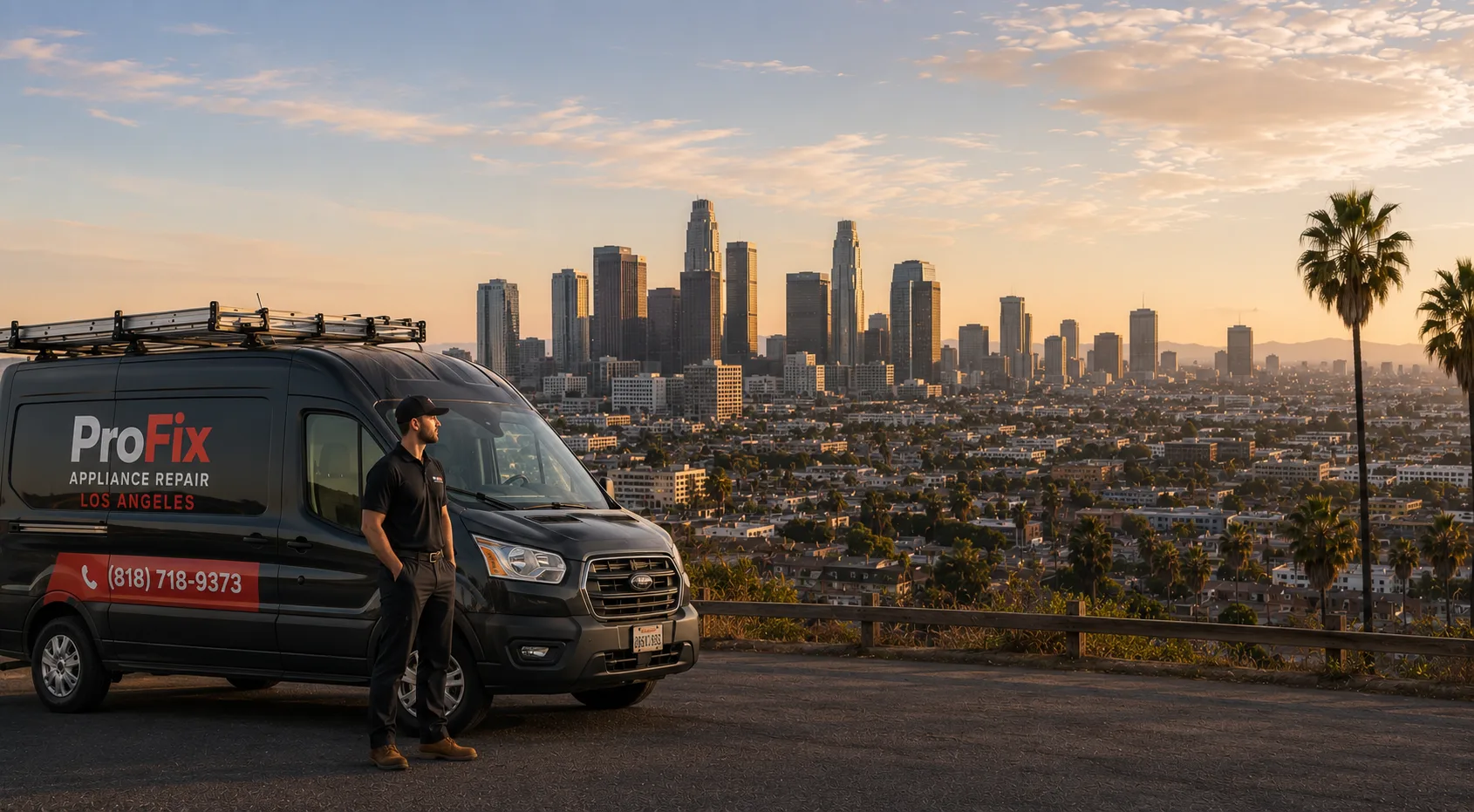
Washer Repair Near Me in Marina Del Rey & Playa Del Rey, Los Angeles County, CA
Yes — we repair washers near you in Marina Del Rey & Playa Del Rey. Local certified technicians cover all 3 zip codes, all brands, same-day availability.
Mon–Sat 7am–8pm · Sun 9am–5pm
Schedule Your Repair
Service Type
What type of service do you need?
Or call us directly:
(818) 334-4526Washer Brands We Repair in Marina Del Rey & Playa Del Rey
All 19 brands serviced — choose yours for brand-specific repair details.



















Other Appliances We Repair in Marina Del Rey & Playa Del Rey
The Wear-and-Tear Reality of Washing Machines
A washer does more mechanical work per year than almost any other appliance in the house — hundreds of spin cycles, each one spinning a drum loaded with wet fabric at speeds up to 1,200 RPM while a suspension system absorbs the imbalance. Every one of those cycles puts stress on bearings, belts, motor mounts, and the electronic control board that sequences the whole process, which is exactly why washers generate more service calls than almost any other household appliance.
In Los Angeles specifically, we see two local factors show up again and again. First, many households — especially in older apartment buildings and converted units across Central LA and the Valley — run stacked or compact units in tight closet installations with limited ventilation, which traps heat and moisture around the motor and control board longer than a well-ventilated laundry room would. Second, water hardness varies meaningfully by neighborhood across the county, and harder water accelerates mineral scale buildup inside inlet valves and detergent dispensers, which is a common root cause of slow-fill and no-fill complaints we diagnose.
What Actually Breaks: The Repairs We Make Most
Drainage problems — a washer that fills and agitates fine but won't pump the water back out — are one of the top calls we get, and the cause is almost always a clogged drain pump filter, a kinked or crushed drain hose, or a failed drain pump motor. Spin-cycle failures are a close second: a machine that agitates and washes normally but won't spin at the end of the cycle usually points to a broken drive belt, a worn motor coupling, or on front-load units, a door lock/latch assembly that's failed and is preventing the control board from allowing high-speed spin as a safety measure.
Excessive vibration and loud banging during spin is almost always a suspension or leveling problem — worn shock absorbers on front-load machines, a broken spider arm on the inner drum, or simply a unit that's out of level on the floor, which is a five-minute fix if that's really all it is. Leaks show up from several different points and the location tells us a lot before we even open the cabinet: leaking from the front usually means a torn door gasket on a front-load unit, leaking from the back typically points to a hose connection, and leaking from underneath the drum usually means a bearing or seal has failed inside the tub itself, which is a more involved repair.
Front-Load vs. Top-Load: Different Failure Patterns
Front-load washers, which are extremely common across LA's condos and apartment buildings for their stacking capability and efficiency, are more prone to door gasket mold and musty odors than top-load machines, simply because the door stays sealed between cycles and moisture has nowhere to escape. We recommend leaving the door cracked open between loads and running a monthly cleaning cycle, and if the odor is already established, a gasket replacement is often more effective long-term than repeated cleaning.
Top-load washers, especially older agitator-style models, see more issues with the agitator dogs (the small ratcheting components that let the agitator twist without spinning the whole tub) wearing out, along with lid switch failures that stop the machine from spinning as a safety interlock. High-efficiency top-load machines without a center agitator have their own quirks, particularly around load-balancing sensors that pause a cycle repeatedly if the load isn't distributed evenly.
Repair Costs and What a Visit Looks Like
Most washer repairs run $150–$400 and take one to two hours, with drain pumps, inlet valves, door latches, and belts being the parts we carry on the truck for same-day completion. A control board replacement or a full bearing/tub-seal job runs toward the higher end of that range and, on an older unit, is the point where we'll walk you through whether repair still makes sense versus putting that money toward a new machine.
Every repair is diagnosed with the actual error code or symptom pattern first — modern washers display specific fault codes (UE for unbalanced load, OE for drain error, LE for motor lock, and others depending on brand) that point our technicians directly to the likely failure point before a single part is ordered, which keeps unnecessary part-swapping and repeat visits to a minimum.
Preventing the Repeat Service Call
Overloading is the single most common cause of premature washer wear we see, and it's entirely preventable. A drum packed beyond the manufacturer's recommended capacity forces the motor, bearings, and suspension system to work far harder than designed, and it's a leading contributor to the belt failures, bearing noise, and motor burnout we're called out to repair. Leaving roughly a quarter of the drum's space free lets clothes move and rinse properly while cutting mechanical strain significantly.
Using the correct detergent type matters more than most people realize, particularly for high-efficiency front-load and low-water top-load machines, which require HE-formulated detergent that produces fewer suds. Regular detergent in an HE machine creates excess suds that the machine has to fight against, which can trigger error codes, extend cycle times, and leave residue that eventually affects drainage and odor.
For households in LA's harder-water neighborhoods, a monthly cleaning cycle using a washer-cleaner tablet or a cup of white vinegar helps prevent mineral scale from building up inside the tub, inlet valve, and detergent dispenser — the same scale buildup that's behind a meaningful share of the slow-fill and no-fill complaints we diagnose.
Reading Your Washer's Warning Signs Early
A washer rarely fails without warning — it usually signals a developing problem for weeks before it stops working entirely, and catching those early signs saves both money and the inconvenience of a sudden breakdown mid-load. A spin cycle that's gradually gotten louder over several months, a slight vibration that's crept up even on balanced loads, or a wash cycle that's started taking noticeably longer than it used to are all worth having checked before they progress to a full stop.
Error codes that appear once and then clear on their own are worth noting even if the machine seems to recover and finish the cycle normally, since an intermittent fault that resolves itself once often becomes a persistent one within a few more cycles. Writing down the exact code and what the machine was doing when it appeared gives our technicians a real head start on diagnosis rather than working from a vague 'it made a weird noise once' description.
For households with an aging washer they're trying to get another year or two out of, we can perform a proactive inspection focused on the highest-wear components — belt condition, bearing play, suspension rod wear — and flag anything that's close to failing before it takes out other parts around it or leaves you without a working washer on a day you need it most.
We also see a fair number of calls where the washer itself is working correctly but the household's water supply is the underlying issue — low household water pressure feeding a slow fill, or a partially closed supply valve behind the machine that was never fully reopened after a move or renovation. Checking supply-side basics takes just a minute and rules out an unnecessary parts replacement before we assume the machine itself has failed. Rubber supply hoses also have a service life of their own, generally recommended for replacement every five years regardless of visible wear, since a burst supply hose is one of the more damaging household failures a washer can cause if it happens while no one is home.
Washer Repair Snapshot
Front-load and stacked units common in LA's apartment and condo stock have their own recurring failure patterns, particularly around door gaskets and moisture.
Washer Repair in Marina Del Rey & Playa Del Rey — FAQ
Can't find your answer? Book a service call or call us now.
Still have questions?
Our LA team is ready — same-day service across Los Angeles County.
Ready to fix your washer in Marina Del Rey & Playa Del Rey?
ProFix Appliance Repair Los Angeles — certified technicians already in Marina Del Rey & Playa Del Rey. Same-day slots available.